Rafidain Museum
35 of Iraq’s most famous artefacts, from Sumer to the Abbasids: their story, their age, where they came from and where they are today.
28 of these 35 pieces are outside Iraq today.
Where are these pieces today?
- 16 British Museum, London
- 6 Iraq Museum, Baghdad
- 5 Louvre, Paris
- 2 Penn Museum, Philadelphia
- 2 Pergamon Museum, Berlin
- 1 At the site of Babylon
- 1 Ashmolean Museum, Oxford
- 1 Columbia University, New York
- 1 National Museum of Asian Art (Freer), Washington
Sumer
c. 3500–2000 BC · The first cities, writing and schools-
c. 3300–3000 BC
Uruk Trough
A carved stone trough showing a flock of sheep coming out of a reed hut, probably used in the temple of the goddess Inanna.
-
c. 3200–3000 BC
Warka Vase
One of the world’s oldest narrative carvings: rows of crops, animals and people bringing offerings to the goddess Inanna. Looted from the museum in 2003 and later returned.
-
c. 3100 BC
Mask of Warka (Lady of Uruk)
One of the earliest near life-size depictions of a human face, once inlaid with coloured eyes and brows. Stolen in 2003, it was found buried in an orchard and returned.
-
c. 2900–2550 BC
Sumerian worshipper statues
Small statues of men and women with clasped hands and wide eyes, placed in temples to pray on their owners’ behalf.
-
c. 2600 BC
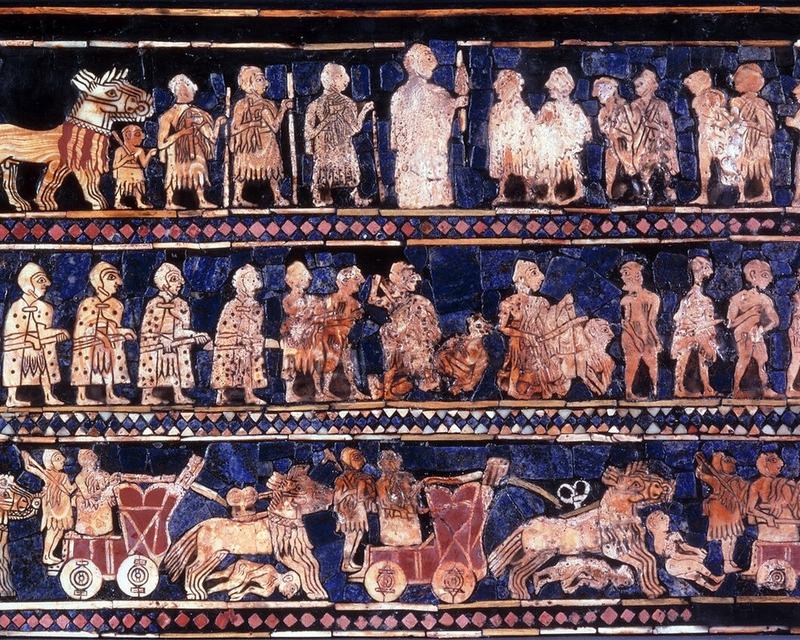
Standard of Ur
A wooden box inlaid with shell, lapis lazuli and red stone, with a ‘war’ side and a ‘peace’ side, and some of the earliest images of wheeled vehicles.
-
c. 2600 BC
Queen Puabi’s headdress
Leaves and flowers of solid gold found on a Sumerian queen in the Royal Cemetery of Ur, with jewellery of lapis lazuli and carnelian.
-
c. 2600–2400 BC
Ram in a Thicket
A pair of near-identical figures of a goat rearing up against a tree, in gold, silver and lapis lazuli. One is in London, the other in Philadelphia.
-
c. 2500 BC
The Queen’s Lyre of Ur
One of the world’s oldest stringed instruments, crowned with a golden bull’s head. The Iraq Museum holds another golden lyre from the same cemetery.
-
c. 2600–2400 BC
Royal Game of Ur
A twenty-square board game whose rules were decoded from a later Babylonian tablet, and which people still play today.
-
c. 2450 BC
Stele of the Vultures
Celebrates King Eannatum of Lagash’s victory over Umma: helmeted soldiers in a tight phalanx and vultures carrying off enemy heads, one of the earliest images of organised warfare.
Akkad
c. 2350–2150 BC · The first empire in history-
c. 2300 BC
Disk of Enheduanna
Shows Enheduanna, daughter of Sargon of Akkad and high priestess of the moon god at Ur, the first author in history known by name, whose hymns are still read.
-
c. 2250 BC
Victory Stele of Naram-Sin
The Akkadian king climbs a mountain over his enemies, one of the first carvings to tell a single rising scene. The Elamites carried it off to Susa as war booty.
-
c. 2250 BC
Bassetki Statue
A copper statue of a seated youth whose base names King Naram-Sin, found by chance in the village of Bassetki near Duhok in 1974.
Babylon
c. 1900–539 BC · Law, mathematics and astronomy-
c. 1800 BC
Sumerian King List (Weld-Blundell Prism)
A four-sided clay prism listing the kings of Sumer from when ‘kingship descended from heaven’ to the Old Babylonian period, mentioning the Flood.
-
c. 1800 BC
Plimpton 322
A Babylonian mathematics tablet with a table of Pythagorean triples, written more than a thousand years before Pythagoras.
-
c. 1800–1750 BC
Queen of the Night (Burney Relief)
A clay plaque of a winged goddess with bird’s feet standing on two lions between two owls, probably Ishtar or her sister Ereshkigal.
-
c. 1754 BC
Code of Hammurabi
A black basalt stele with about 282 laws, topped by the king receiving them from Shamash, god of justice. It was found at Susa in Iran in 1901.
-
c. 1750 BC
Nanni’s complaint to Ea-nasir
The oldest known customer complaint (right-hand tablet): a man named Nanni protests to a copper merchant in Ur who sold him poor goods and treated him rudely, and wants his money back.
-
12th century BC
Kudurru of King Melishipak
A Kassite boundary stone in which the king presents his daughter to the goddess Nannaya, beneath the crescent, sun and star of Sin, Shamash and Ishtar.
-
date debated
Lion of Babylon
A basalt lion standing over a man, one of the few large pieces still in its original place today.
-
c. 575 BC
Lions of the Processional Way
Some 120 glazed-brick lions lined the road to the Ishtar Gate, and the gate itself was rebuilt in Berlin.
-
c. 6th century BC
Babylonian Map of the World
The oldest known map of the world: Babylon in the centre on the Euphrates, ringed by the ‘Bitter River’ and distant islands.
-
after 539 BC
Cyrus Cylinder
A clay cylinder written after the Persian king Cyrus entered Babylon in 539 BC, and found in Babylon itself in 1879.
Assyria
c. 900–612 BC · The palaces of Nineveh and Nimrud and their carvings-
9th century BC
Balawat Gates
Hammered bronze bands that decorated huge wooden gates at Imgur-Enlil (Balawat, near Nimrud), showing the campaigns of Shalmaneser III.
-
c. 825 BC
Black Obelisk of Shalmaneser III
A black limestone obelisk from Nimrud recording the victories of King Shalmaneser III and the tribute brought to him by neighbouring kingdoms.
-
9th–7th century BC
Woman at the Window (Nimrud ivory)
A small ivory plaque of a woman looking out of a balconied window, one of thousands of ivories that adorned the furniture of Nimrud’s palaces.
-
c. 713–706 BC
Lamassu (winged bull)
Guardians of Sargon II’s palace gates at Khorsabad, with a human head, bull’s body and eagle’s wings, and five legs so it seems to stand from the front and walk from the side.
-
c. 700 BC
Lachish reliefs
Carvings from Sennacherib’s palace at Nineveh telling the siege of Lachish step by step: siege engines, walls and captives.
-
c. 691 BC
Taylor Prism
A six-sided clay prism recounting King Sennacherib’s campaigns, including his siege of Jerusalem in the time of King Hezekiah.
-
7th century BC
The Flood Tablet
Tablet eleven of the Epic of Gilgamesh, from Ashurbanipal’s library at Nineveh, telling of a great flood. When George Smith read it in 1872 it stunned the world.
-
c. 645 BC
Garden relief of Ashurbanipal
A procession of musicians approaching courtiers before the wall of the palace garden at Nineveh, a rare glimpse of daily life at the Assyrian court.
-
c. 645–635 BC
Lion Hunt of Ashurbanipal
Carvings from the palace at Nineveh, masterpieces of Assyrian art, showing the king hunting lions with striking detail of movement and pain.
Hatra
1st–3rd century AD · The caravan city that held out against Rome-
2nd century AD
Statue of Sanatruq I, King of Hatra
The king of Hatra in richly decorated robes raising his hand in greeting, from a city that withstood two Roman sieges.
Abbasids
750–1258 AD · Baghdad and Samarra, capitals of the world-
9th century AD
Abbasid stucco from Samarra
Carved stucco panels that decorated the palaces of Samarra and spread a decorative style copied as far as Egypt.
-
9th–10th century AD
Abbasid lustreware bowl
A bowl signed by the potter Khalid, made with the metallic-lustre technique that Iraqi potters invented in the Abbasid era to imitate gold, which then spread across the Islamic world.
Photos: Osama Shukir Muhammed Amin FRCP(Glasg) · Wikimedia Commons · CC BY-SA 4.0 | Nate Loper from Flagstaff, AZ, USA · Wikimedia Commons · CC BY 2.0 | Szilas · Wikimedia Commons · CC BY-SA 4.0 | Rama · Wikimedia Commons · CC BY-SA 3.0 fr | Gary Todd · Wikimedia Commons · CC0 | Photograph by Mike Peel (www.mikepeel.net). · Wikimedia Commons · CC BY-SA 4.0 | Unknown authorUnknown author · Wikimedia Commons · Public domain | photo author unknown · Wikimedia Commons · Public domain | Gary Todd from Xinzheng, China · Wikimedia Commons · CC0 | Wikimedia Commons · Public domain | Mary Harrsch · Wikimedia Commons · CC BY 2.0 | Fred Romero · Wikimedia Commons · CC BY 2.0 | Mike Peel · Wikimedia Commons · CC BY-SA 4.0 | Wikimedia Commons · CC BY 3.0 | Dosseman · Wikimedia Commons · CC BY-SA 4.0 | Unknown artistUnknown artist · Wikimedia Commons · CC BY-SA 3.0 | Mefman00 · Wikimedia Commons · CC BY 4.0 | Unknown artistUnknown artist · Wikimedia Commons · Public domain | This image was produced by me, David Castor ( · Wikimedia Commons · Public domain | Allan Gluck · Wikimedia Commons · CC BY 4.0 | Daderot · Wikimedia Commons · Public domain | Zunkir · Wikimedia Commons · CC BY-SA 4.0